
How to choose your breeder
Before choosing a breeder, it is essential to check whether they meet ethical standards, that is, whether they carry out health tests on their breeding dogs, whether they select the best individuals for breeding, and whether they (and their dogs) are registered with the Canadian Kennel Club, and so on.
To learn more, see the criteria of the ethical breeder further down this page.
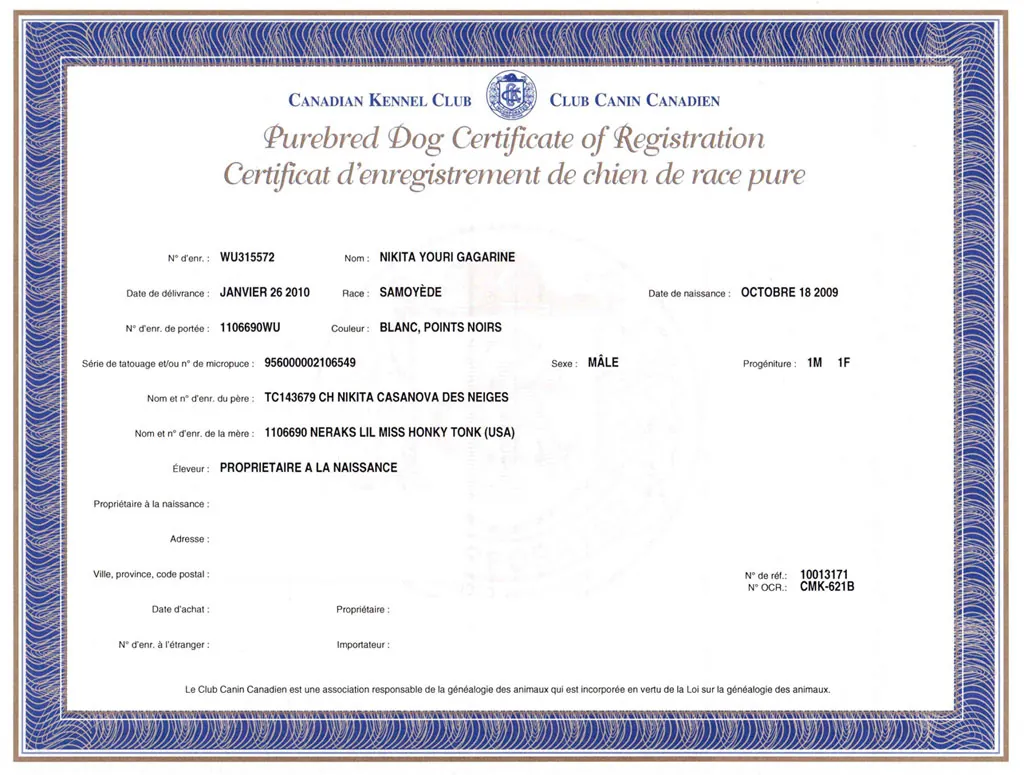
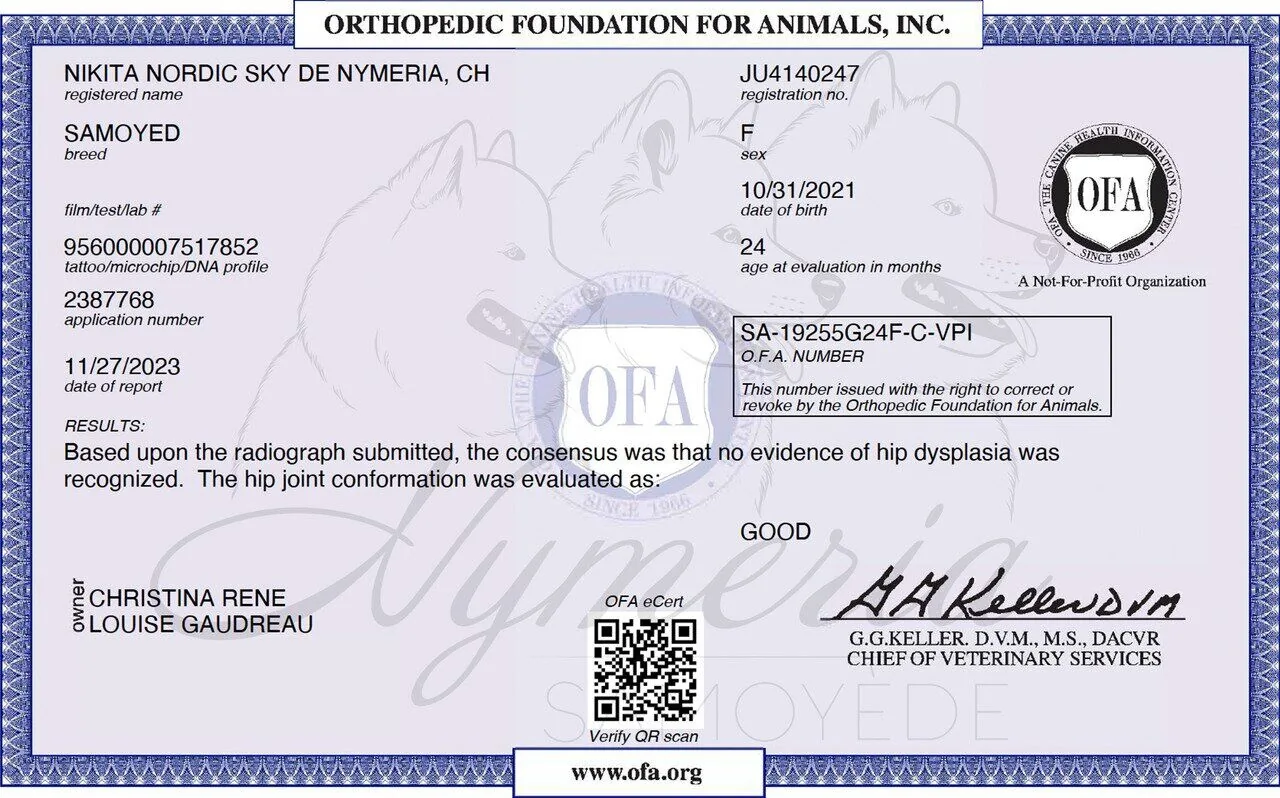
Before adopting and signing a contract with the breeder you have selected, ask for the kennel’s and breeding dogs’ Canadian Kennel Club registration certificates as well as the OFA health tests (hips, eyes and heart).
To check whether the breeding dogs are OFA tested, see our Health section and our OFA Certification page. They explain how to search online using the breeding dogs’ Canadian Kennel Club registered names.
The Canadian Kennel Club is the sole organization that administers the Animal Pedigree Act. Among other things, this Act states that a purebred animal must hold a certificate confirming its origins.
So, to certify by contract that you really are buying a purebred Samoyed, the breeder must be able to provide their CKC certificate. The certificate is your only proof confirming that the dog truly is purebred. Moreover, since the fees for registering litters and puppies with the CKC are minimal, no serious breeder should tell you that registration raises the price of the puppy significantly. These fees are an integral part of an ethical breeder’s responsibilities.
Examples of certificates to ask your breeder for
Canadian Kennel Club (CKC) registration certificate: This official document confirms that the dog is purebred and registered in the national registry. The breeder must be able to provide it for every puppy sold.
OFA certificate (hip test): This certificate from the Orthopedic Foundation for Animals confirms that the breeding dog’s hips have been evaluated and certified. Possible results range from “Excellent” to “Fair.” Require OFA certifications for the hips, eyes and heart of both parents.
Criteria of the ethical breeder
Breeder members of the Club Samoyède du Québec must meet all of the following criteria to become members. The Club advocates ethical breeding for the preservation of the breed.
Here are the Club’s criteria for the ethical breeder:
- Is a member of the Canadian Kennel Club* (mandatory). Only dogs registered with the Canadian Kennel Club may be sold with the designation “Purebred dog.”
- Is a member of one or more clubs specific to their breed.
- Breeds only from dogs with a sound temperament and free of health problems that could be passed on to the puppies. In the Samoyed, as in many breeds, the hips must be certified by the OFA at 2 years of age, and an eye examination by an ophthalmologist is required every year. There are also 3 other recommended tests that allow the breeding dog to obtain an optimal health certification called OFA CHIC.
- Shows their dogs in canine competition to ensure the future parents meet the breed standard. The breeder is proud of their dogs.
- Meets clients in person before accepting them as future owners: many ask buyers to fill out a questionnaire to get to know them better.
- Does not use high-pressure sales and generally keeps a waiting list of clients.
- Does not let puppies go before 8 weeks of age, and many do so around 10 weeks; this is an important period for the puppy’s socialization.
- Ensures the dam has very few litters in her lifetime (generally 3 or 4) and not at every heat cycle.
- Offers you a written guarantee against hereditary diseases of at least two years and a lifetime consultation service.
- Generally takes the dog back, or helps you rehome it, if you cannot keep it for one reason or another.
- Gives you advice on care, behavioural issues, and so on: the breeder is your go-to resource when you have a problem, especially in the first months after adoption.
* Canadian Kennel Club: the only registry for purebred dogs in Canada.
Scams in the puppy market
As Émilie Veillette points out on the Canidée website, a number of people may try to scam you when you adopt your puppy.
Here are a few signs of a scammer:
- Unregistered puppies at a reduced price: If a breeder offers you a lower price for an unregistered puppy, run! This breaches the CKC Code of Practice for members who breed dogs. Also, be aware that a dog cannot be sold as “purebred” if it has no registration (Animal Pedigree Act).
- Puppies ready too early: The breeder tells you the puppies will be ready to leave at 6 or 7 weeks? The answer is NO! It is strictly forbidden to sell a puppy before 8 weeks of age (Quebec’s Regulation respecting the safety and welfare of cats and dogs).
- Sale in a pet store: You ask the pet store where the puppies come from and are told they come from breeders? Know that no ethical breeder sells puppies in pet stores. This also breaches the CKC Code of Practice for members who breed dogs. The breeder in question belongs to the third category: a “backyard breeder.”
- Inflated prices for crossbred dogs: A goldendoodle sold for $3,000 on Kijiji? Run, fast! Crossbred (or “mixed”) dogs are often very good dogs that deserve just as much love and affection; that is not the point, we love them too! The problem is when people sell them at completely outrageous prices.
Source: Émilie Veillette, “Adopter un chien : l’adoption responsable” (in French), Canidée (canidee.ca).
Telling breeders apart
In the same article on the Canidée website, Émilie Veillette explains the difference between the various kinds of breeders.
The ethical breeder is the cream of the crop. But what about the other “breeders” who sell dogs? According to Émilie, breeders can be sorted into 3 categories:
- First, there are ethical breeders, who meet a whole range of criteria such as those listed above: they carry out all the health tests, register their dogs with the CKC and offer lifetime follow-up.
- Second, there are hobby breeders, who breed their dogs and take good care of them but do not meet the criteria listed above. For example, they do not test their breeding dogs for the diseases associated with the breed.
- Finally, there are those commonly called “backyard breeders” or “puppy mills.” This last category is to be avoided at all costs, because puppies are sold there with a single goal: making money. The health and well-being of the breeding parents are the least of their concerns; the females are forced to breed again and again, in appalling conditions.
Source: Émilie Veillette, “Adopter un chien : l’adoption responsable” (in French), Canidée (canidee.ca).
10 questions to ask a breeder
The Canadian Kennel Club is the reference for dog breeders in Canada. It recommends asking these essential questions of any breeder before reserving a puppy, to confirm that the breeder meets ethical standards:
- How long have you been breeding this breed?
- What health tests have you performed on the parents?
- May I see the OFA certificates and the CKC registration?
- May I meet the mother (and the father if available)?
- How do you socialize your puppies?
- What sales contract do you offer?
- What health guarantee do you offer?
- Will you take the dog back if I can no longer keep it?
- Can you provide references from families who have adopted from you?
- Which breed clubs are you affiliated with?
Responsible adoption
To learn more about responsibly adopting a puppy, we recommend the Canidée article “Adopter un chien : l’adoption responsable” (in French); see also the Canadian Kennel Club website.