
Preparation
Given the excitement that the arrival of your new Samoyed puppy at home can bring, it is recommended to prepare a safe place for it in advance. A Samoyed puppy is playful and naturally curious about exploring and finding things that could harm it. Many puppies have become sick and have even died after harmful discoveries such as nails, plant leaves, detergents, medications, antifreeze (which tastes sweet), electrical cords, chocolate candy, electrical appliances, and so on. It is your responsibility to protect your puppy from these potential dangers. Gates and crates are an excellent way to confine your puppy and protect it from dangerous situations. They also help you start an appropriate training program.
Inside the home
Making your home safe for the puppy (“puppy proofing”) requires the same kind of precautions as preparing the home for the arrival of a baby. Electrical cords must be hidden or out of reach, and plug protectors or covers must be placed over electrical outlets. Venetian blind cords and telephone cords must also be hidden and out of reach.
Household detergents, cleaning agents, medications, chocolate, chemicals, paint, light bulbs, paper clips, pens, staples and so on must be stored safely and out of the puppy’s reach. In short, don’t leave anything lying around! Also keep an eye on the toys you give your puppy to prevent it from ingesting the stuffing from plush toys or bits of plastic or fabric. Check, too, that your dog cannot open doors. Many houseplants that may seem harmless can be deadly to the dog.
Outside the home
It is also important to make the outside of your home safe for your puppy. The puppy should not be left outside unsupervised. Rocks, as well as all types of balls (for example tennis, ping-pong or golf balls), twigs, tree branches and so on can be swallowed and cause a deadly intestinal blockage. Outdoor plants such as lilies, bulb plants (that is, irises, hyacinths, daffodils, etc.), holly and other conifers are toxic and should not be anywhere the puppy can chew on them.
Arriving home
When you arrive home for the first time, let the puppy relieve itself outdoors first. Then introduce it to its new environment: a safe, warm and comfortable place that has been prepared for it, where it can relax and play. Its new home and surroundings will seem strange to it and could make it fearful. It is advisable to let it sniff and explore its new area to reduce its fear.
During the first few days, avoid piling on meetings with family and friends. The puppy should first get to know each member of the family, then gradually the wider circle. Children must learn to approach it and handle it with care so as not to frighten or hurt it. Samoyed puppies are strong and can wriggle to get free and take bad falls when you hold them in your arms. To avoid this, it is a good idea to have young children sit down when they hold a puppy.
Diet
The “puppy” period is a critical stage for the animal’s health as well as its learning. It is essential to provide it with appropriate health care and nutrition. The breeder should recommend an appropriate diet and even provide a small amount of the food the puppy has been used to, until you can get some yourself. Keeping the puppy on the same suitable diet will protect it from upset stomachs caused by changes in food. When making dietary changes, it is always wise to make a transition and proceed gradually. Overfeeding can also cause digestive problems and affect your puppy’s health. It is best to feed your puppy at the same time each day and to make sure fresh water is available at all times.
Settling into the home
The puppy must get used to the home and, more specifically, to the place prepared and reserved for it: a clean, comfortable and secure spot where it will be confined at first. Ideally, the area or room should have a washable, non-slip floor. Keep in mind that, by instinct, a dog will not normally relieve itself where it sleeps. We strongly recommend using a convertible crate (with a divider) that you adapt as the dog grows.
The puppy’s space must be free of dangerous or valuable objects. Learning about the home and its own space is an important step for the new puppy as well as for you. The crate is an essential tool that serves both for the puppy’s safety and as a house-training aid.
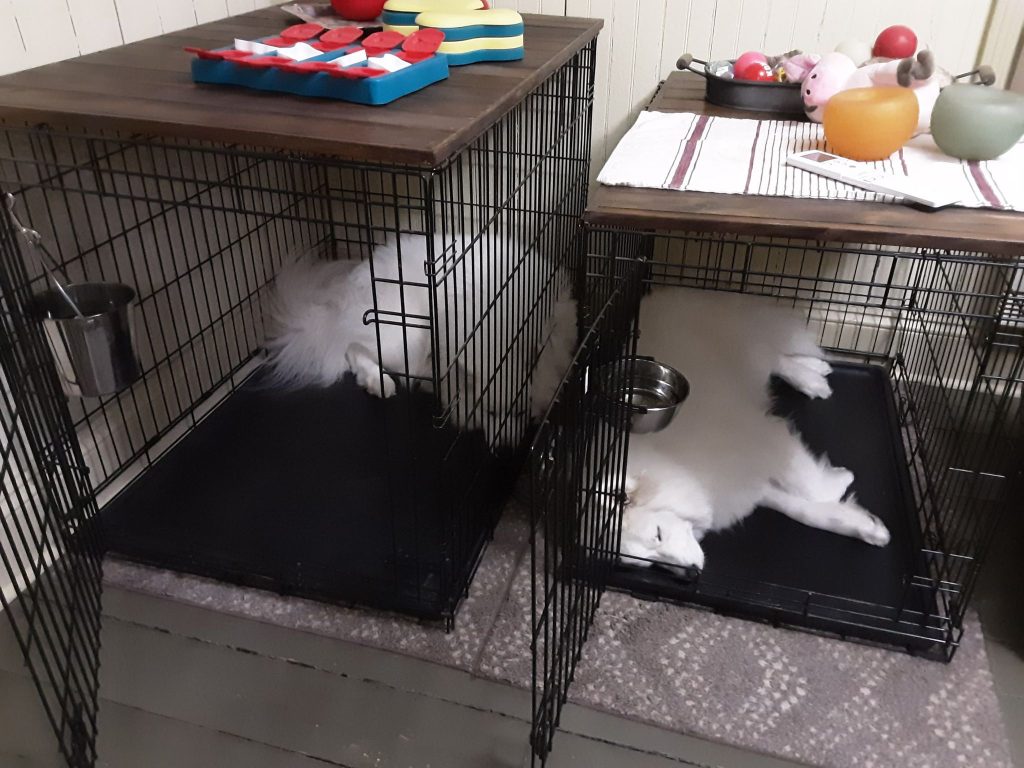
For the first few nights, the puppy may be afraid of being alone and may cry and refuse to sleep. It simply needs to be reassured. As much as possible, we advise placing it near you for the first nights, and you can gradually move it away until it reaches its own space.
Grooming and training
As the owner of a Samoyed, you must devote time and energy to the proper grooming, training, attention and loving care your puppy or dog needs.
This mainly means regular brushing, appropriate nail trimming and a consistent level of exercise. Good nutrition and keeping an eye on its general health are also a must. But although it may seem that a Samoyed needs more than the average amount of attention and care, the love you receive in return from your Samoyed will far exceed your wildest expectations. Your friends will no doubt be amazed by the irresistible beauty, intelligence and unique character of the “Samoyed.”