
Did you know?
Discover fascinating facts about the Samoyed, its history and its unique traits.
Can’t find your answer? Ask the club
Origins and characteristics
There is a very specific reason for the Samoyed smile
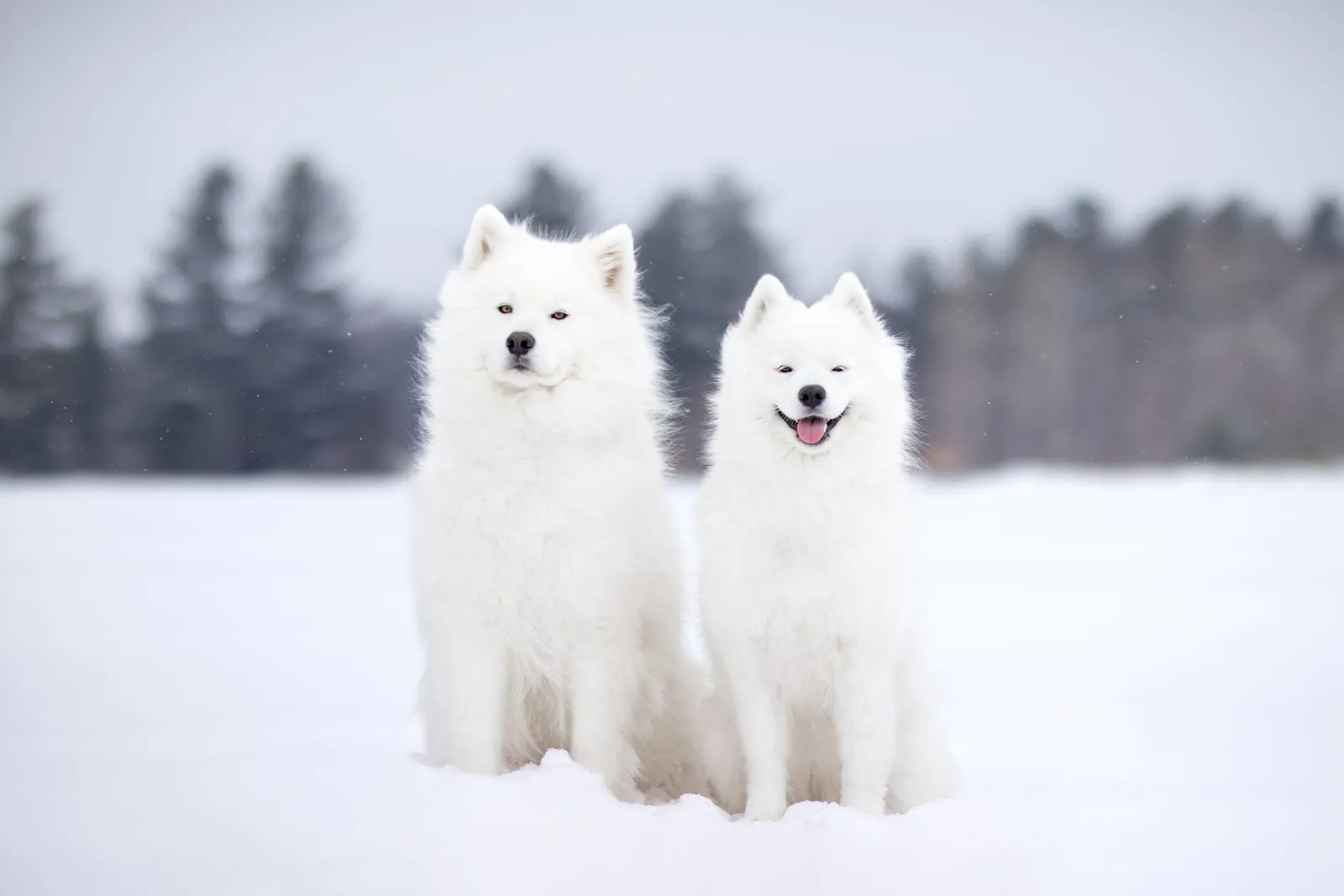
The famous Samoyed smile is no accident.
Charming as it is, it actually protects the dog from the cold! Since the Samoyed comes from Siberia, where extreme cold prevails, it needs to protect itself from the cold as well as possible. The hooked shape of its mouth and its tight lips keep it from producing streams of drool.
Otherwise, the saliva would form icicles and create a risk of frostbite and many other problems for our famous northern dog.
Besides the fact that it is wonderful to have a dog that does not drool and smiles all the time, the reason is entirely practical!
The Samoyed owes its name to a British zoologist
The name is a fairly recent one; the original names have been forgotten. In the late 19th century, Samoyeds were brought from Siberia to take part in polar expeditions. The British zoologist Ernest Kilburn Scott was the first to bring one back to England. Bjelkier is the generic Russian term for the breed, and that is what his British friends first called it.
However, Kilburn Scott renamed the breed "Samoyed" when he founded the Samoyed Club of England in 1909, drawing his inspiration from the Samoyede tribe with which the Samoyed lived and still lives today.
The plumed shape of the Samoyed’s tail has several advantages
The plumed tail of the Samoyed is a distinctive feature of the breed. It is carried curled over the back, creating that majestic look. This feature is functional and evolved to help Samoyeds survive in their original environment, the Arctic regions of Siberia.
The plumed shape of the tail has several advantages:
- Thermal insulation: by wrapping their tail around their body, including over their muzzle, Samoyeds can use their dense fur to protect themselves from extreme cold; it acts as extra insulation.
- Protection from the elements: the curled position of the tail offers protection against harsh weather, including icy wind and snow, keeping it from freezing, among other things.
- Expressiveness: the way Samoyeds carry their tail often says a lot about their emotional state. A plumed tail can signal excitement, curiosity or contentment.
In short, the Samoyed's plumed tail is an evolutionary adaptation with practical advantages in cold climates, while adding to the breed's distinctive look and its ability to communicate visually.
The coat
No dog breed is 100% hypoallergenic
However, some breeds, including the Samoyed, are thought to produce fewer allergens thanks to their natural characteristics, which by definition makes them less allergenic. These breeds will not prevent allergic reactions 100%, but their hair, dead skin cells and saliva will cause you fewer problems. In some cases, allergy attacks will be much less severe.
About 95% of people allergic to dogs are not, or only very mildly, allergic to the Samoyed. A test before adoption is nonetheless recommended.
The Samoyed coat has self-cleaning properties
Its self-cleaning qualities cannot, however, replace regular grooming and brushing…
With its two distinct layers, the Samoyed's coat offers protection against dirt thanks to its self-cleaning texture and natural water-repellent properties. Adapted to Arctic conditions, the dense undercoat acts as thermal insulation and keeps dirt and moisture from clinging to it.
Although these characteristics minimize dirt build-up, regular brushing remains essential to prevent knots, remove dead hair and keep the coat healthy overall.
Please follow your breeder's recommendations for grooming your Samoyed.
The Samoyed coat can contain one or more black hairs
Although Samoyeds are known for their white, cream or biscuit coat in keeping with the breed standard, they can sometimes have a few scattered black hairs. This is explained by genetics inherited from ancestors whose fur was sometimes darker.
The genes responsible for coat colours, even recessive ones, can still show up today. A dog's coat colour is determined by several genes, including those responsible for producing pigments:
- Eumelanin: black or brown pigment.
- Pheomelanin: red or yellow pigment.
The genes responsible for coat colour can be passed down over several generations. A dog can inherit recessive or dominant genes from its ancestors that are not expressed right away but can reappear in future generations.
Some individuals may still carry alleles for darker coat colours. If a Samoyed inherits alleles for eumelanin production from its ancestors, it can therefore have one or more black hairs scattered through its coat.
Health and testing
5 health tests are required for the Samoyed
To obtain its CHIC certification, which qualifies it as a healthy breeding dog, the Samoyed must pass the following 5 health tests: a heart examination by a certified cardiologist, an eye examination by a certified ophthalmologist, a hip X-ray graded by the OFA (a passing grade being Excellent, Good or Fair), and the test for inherited genetic diseases, which covers, among others, two inherited eye diseases.
You can also look up the results yourself on the OFA website by entering the parents' names. We explain how here: OFA Certification.
If the breeder cannot provide the results of the required tests and you do not see them online, ask yourself some questions… Health tests are essential and should be the foundation of any breeding program, to minimize health risks for the puppies and give them every chance of a long, happy life.
CHIC certification is obtained once all the health tests required for the breed have been completed; a CHIC certificate is then issued for the dog. Note: it can only be obtained after age 2, since some tests, including the eyes and hips, require a minimum age of 2 to be valid. The eye test must also be repeated every year, since genetic diseases can appear at any age.
The breeder should be able to provide this certificate for all of their breeding dogs.
The SNAP 4DX Plus test
Given the significant rise of diseases transmitted by ticks and mosquitoes, veterinarians now recommend doing the SNAP 4Dx Plus test every year.
It is an inexpensive blood test, and you get the results in just 8 minutes. The test detects heartworm as well as three tick-borne diseases (Lyme disease, anaplasmosis and ehrlichiosis).
The symptoms of these diseases are rarely visible, which means they are often detected at a very advanced stage. The SNAP 4Dx Plus detects them quickly and maximizes the effectiveness of treatment, if needed, while preventing serious consequences for your dog's health.
Ask your veterinarian about adding this annual test to your dog's health routine.
Without a registration certificate, the Embark genetic test can build your dog’s genetic and health profile
A Samoyed without registration papers cannot be considered purebred, nor be sold as such, within the meaning of the law. To be recognized as purebred, it must have a registration certificate from the Canadian Kennel Club or another recognized breed registry.
However, for those without this proof, a genetic test with Embark is possible. The Embark genetic test checks your Samoyed's breed purity by analyzing its DNA. It also provides valuable information about your dog's health by identifying genetic predispositions to certain diseases and conditions.
These tests are known for their reliability, using advanced technology to analyze thousands of genetic markers. This ensures highly accurate results, giving owners greater confidence in the information obtained.
You can thus get a clear picture of your companion's genetic heritage and health.
Regulation and ethics
It is illegal to sell a dog as “purebred” without providing papers
Canada's Animal Pedigree Act prohibits selling a dog as purebred without providing its Canadian Kennel Club certificate proving it. Otherwise, the seller is liable to prosecution.
To comply with this law, a breeder who claims to sell a purebred dog must provide the new owners with the purebred registration certificates of both breeding dogs (mother and father).
Without a registration certificate, your dog cannot be considered purebred.
The registration certificate of a breeding dog must have a blue border.
Under section 29.1 of the Canadian Kennel Club By-laws, the seller (breeder) is responsible for giving the buyer (new owner) a purebred registration certificate, at no additional cost, within six months of the puppy's date of sale.
If the new owner does not receive the certificate in time, they can file a complaint against the breeder for non-delivery of the registration certificate. Simply contact CKC Member Services toll-free at 1-855-364-7252 or by email at information@CKC.ca to let them know about the situation.
Besides confirming that your puppy is purebred, the certificate proves that you are its owner: when issuing the registration certificate in your name, the CKC enters your contact information and your puppy's microchip number in its database. If your dog is lost or stolen, the SPCA that finds it or the police, as the case may be, will search the CKC database with its microchip number to find you. And if anyone disputes your ownership of the dog, your certificate will serve as indisputable proof.
A purebred registration certificate for a non-breeding dog has a green border.
Your puppy’s registration certificate must be provided free of charge
Your breeder is required to provide your puppy's Canadian Kennel Club registration certificate free of charge within a reasonable time (less than 6 months after the date of purchase). If you have not received your puppy's registration certificate and your breeder is still delaying, contact the CKC registration department (information@CKC.ca or 1-855-364-7252) to let them know about the situation.
Besides confirming that your puppy is purebred, the certificate proves that you are its owner: when issuing the registration certificate in your name, the CKC enters your contact information and your puppy's microchip number in its database. If your dog is lost or stolen, the SPCA that finds it or the police, as the case may be, will search the CKC database with its microchip number to find you. And if anyone disputes your ownership of the dog, your certificate will serve as indisputable proof.
It should be noted that under section 29.1 of the Canadian Kennel Club By-laws: "when a dog is sold or otherwise disposed of as a purebred dog for consideration (monetary or otherwise), the person selling or disposing of the dog shall, within six (6) months of the date of sale or disposition, take all necessary action to provide the new owner with a CKC certificate of registration on which shall be recorded all of the required change of ownership information."
Consequently, once the six-month period has ended, if the certificate has not been delivered, the CKC can file a complaint against the breeder on your behalf for non-delivery of the registration certificate.
Ethical breeding involves many criteria beyond official registration with the Canadian Kennel Club or another recognized club
Although some breeders highlight their affiliation with the Canadian Kennel Club or other recognized organizations, this does not automatically mean that their practices are ethical.
Ethical breeding puts the dogs' well-being first, selects breeding dogs rigorously, and is committed to maintaining high quality while following responsible practices.
To choose your breeder well, here are a few key points to consider:
- Health tests and CHIC certification: an ethical breeder has their breeding dogs undergo the health tests recommended for the breed, ideally leading to the OFA's CHIC certification. For the Samoyed, this includes the annual eye exam, the hip test certified after age two, the heart test performed by a cardiologist after age one, and the test screening for the breed's inherited genetic diseases.
- Participation in recognized events: breeding dogs should have proven their excellence and conformity to the standards in one or more disciplines, whether in conformation, in work (such as agility and obedience) or in other activities recognized by kennel clubs.
- Socialization and desensitization: an ethical breeder invests time in socializing and desensitizing their puppies from the very first weeks. This includes getting them used to various environments, sounds, people and situations to support their healthy development and produce well-balanced puppies.
- Number of breeding dogs and litters: an ethical breeder keeps a reasonable number of breeding dogs and limits the number of litters per year, to offer their dogs better conditions and focus on quality rather than quantity.
- Age of breeding dogs: the breeder must respect the minimum age (18 months according to the CKC, although CHIC health certification is only available from age 2) and the maximum age for breeding, ensuring the health and well-being of their dogs.
- Well-being first: an ethical breeder is not motivated by profit. Their main goal is to improve the breed and ensure the dogs' well-being, not to maximize their income.
Pay attention to these details to make an informed choice!